
What's the big deal with social media?
Social media isn’t just shaping your feed — it’s shaping your mind, your desires, and even your soul. Discover how algorithms exploit your impulses, weaken self-control, and amplify the flesh, and why stepping away might be the most important spiritual decision we have made this year. Read and find out "What's the big deal with social media?".


The Big Deal
Many people think social media simply reflects what you like, follow, or engage with. That idea is not just incomplete — it’s dangerously misleading. Social media does more than mirror behavior; it systematically reshapes your mind, impulses, and desires in ways that work against your spiritual and moral goals.
Psychologically, neurologically, and spiritually, mainstream platforms are engineered to weaken self-control and create a split between who you want to be and who the algorithm trains you to become.
Here is what we found in the research:
Digital Dissociation
A hidden online self is formed, constantly shaped by what you see and do — often without your awareness (Turkle, 2011).
Online–Offline Self Split
A growing divide forms between digital behavior and real-world beliefs, as online disinhibition challenges moral and spiritual direction (Suler, 2004; Meshi, Elizarova, Bender, & Verdejo-Garcia, 2020).
Dual Persona Conflict — a growing gap between online impulses and offline intentions (Bargh & McKenna, 2004).
Each of these points would seem to resemble what the Word calls "double minded'(James 4:8, NKJV)
Across neuroscience, psychology, and behavioral economics, the evidence is clear: social media does not simply reflect behavior — it intentionally alters it for engagement and profit. It's no mystery that …‘the love of money is a root of all kinds of evil’ (1 Tim. 6:10, NKJV). This is further evidence.
The Algorithms Create a Person Driven by Impulse, Not Conviction
Modern platforms track two categories of behavior:
Conscious, chosen interests
Unconscious hesitations, impulses, and temptations
Even very short pause signals a “micro-engagement,” and research shows these micro-pauses reveal more about what draws your attention than likes or comments ever could (Epstein, Peysakhovich, & Eckles, 2022).
The algorithm then feeds:
Content that triggers desire
Content that sparks comparison and insecurity
Content that stimulates sexual curiosity
Content that generates emotional reactivity
Psychologists note that social media is “the largest identity-shaping environment ever created” (Twenge, 2017, p. 55).
Spiritually, this mirrors Scripture:
“The flesh lusts against the Spirit…” — Galatians 5:17 (NKJV)
Platforms are built to amplify the flesh — not the Spirit.
“For all that is in the world- the lust of the flesh, the lust of the eyes and the pride of life -is not of the Father..”(1 John 2:16, NKJV)
The Real Hook
Neuroscience research now shows:
Social media triggers reward pathways similar to gambling and addictive substances (Meshi et al., 2020; Montag, Lachmann, Herrlich, & Zweig, 2019).
Visual cues like likes and notifications reduce executive control and activate reward circuits (Turel, He, Xue, Xiao, & Bechara, 2014).
Problematic Instagram use activates brain reward regions in response to Instagram-themed risky behavior cues (Nasser et al., 2020).
These are not metaphors — they are measurable brain effects.
Sexual Content — One of the Most Powerful Drivers
Politics and outrage engage people, but sexual content dominates algorithmic amplification. Investigative reporting shows:
Instagram pushes increasingly sexual content to accounts following minors, even when they follow only preteen influencers (Wells & Seetharaman, 2021).
Meta’s algorithms systematically amplify harmful content for teen accounts (Horwitz, 2023).
Sexualized content produces higher engagement, and algorithms reward and promote it accordingly (Palawat, Charan, Kaur, & Pareek, 2023), demonstrating measurable behavioral impacts across user populations.
Logically: if suggestive content is addictive and profitable, the algorithm will favor it. These systems are designed to capture attention, not cultivate holiness.
The Psychological and Spiritual Consequences
Social Media Sexualized Content Mimics Pornography Addiction
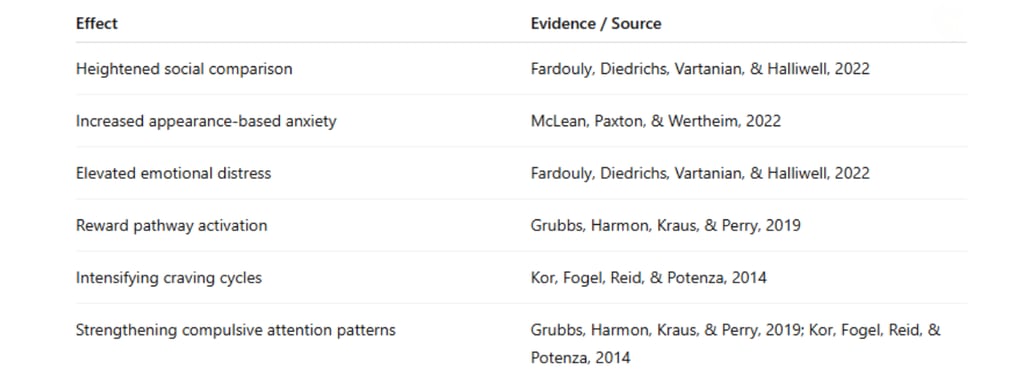
Research shows that exposure to sexualized imagery on social media produces effects strikingly similar to those documented in pornography addiction:
The brain responds to sexually suggestive social media content the same way it responds to pornography—reward pathways, craving cycles, and compulsive behavior are engaged, escalating over time.
Teens and adults now encounter more sexualized content in a week than previous generations saw in years (American Psychological Association [APA], 2021; Barna Group, 2022; Pew Research Center, 2023).
From Subtle to Overt — How Content Slips Past Your Guard
Mild: sensual movement, body-focused angles
Moderate: flirtation, sexual trends
Severe: implied nudity, high-arousal content
Creators escalate suggestive content because the algorithm rewards escalation: sexual content → more views → more engagement → more revenue. The global pornography industry is a $100+ billion market for one reason: sexual content reliably captures attention. Mainstream platforms exploit this same mechanism.
“…the schemes of the devil.” (Ephesians 6:11, NKJV) Are meant to be subtle. Schemes and deceit are hidden by nature.
The flesh is drawn to what is tempting. The Spirit resists. Every click and scroll feeds the algorithm, and it profits from our weakness.
Social media surrounds people with little pressures all the time: moral choices, anger, comparison, and distractions. These pressures build up slowly, so most don’t notice — like frogs in water that’s slowly boiling. Over time, our self-control wears down.
We jumped out. If you’re reading this, you probably feel the heat too.
What This Means for Our Mission
We are called to build tools that cultivate purity, clarity, discipleship, and intentional Christian living — aligning with our mission: empowering faith, fostering community, and supporting charity through online platforms and software creations.
We cannot keep pouring energy into systems that are:
Engineered to exploit temptation
Designed to amplify the flesh
Structured to fragment identity
Built to weaken self-control
Saturated with sexual content
“We wrestle not against flesh and blood, but against principalities, against powers, against the rulers of the darkness of this age…” — Ephesians 6:12 (NKJV)
Today, one of those powers is algorithmic influence. So we are stepping away.
Where We’re Going Instead
We’re turning our focus toward Christian platforms that strengthen believers instead of draining them. That’s why TechForJesus.cloud exists — a directory of Christian tools built to help believers grow without manipulation or moral erosion. That's where you can find Christ centered alternatives.
And specifically, we are moving toward Faithly:
Built for connection, not addiction
No manipulative algorithmic traps
Designed for ministries, pastors, and discipleship
A place free from noise, anger, and temptation
Every Believer Is a Ministry Leader
“We are therefore Christ’s ambassadors…” (2 Corinthians 5:20 NKJV)
Leadership is not about titles — it’s about representation. We invite you to join us on Faithly: a place to grow, encourage one another, and build a Christ-centered community free from the traps of mainstream platforms.
The Big Deal
Many people think social media simply reflects what you like, follow, or engage with. That idea is not just incomplete — it’s dangerously misleading. Social media does more than mirror behavior; it systematically reshapes your mind, impulses, and desires in ways that work against your spiritual and moral goals.
Psychologically, neurologically, and spiritually, mainstream platforms are engineered to weaken self-control and create a split between who you want to be and who the algorithm trains you to become.
Here is what we found in the research:
Digital Dissociation
A hidden online self is formed, constantly shaped by what you see and do — often without your awareness (Turkle, 2011).
Online–Offline Self Split
A growing divide forms between digital behavior and real-world beliefs, as online disinhibition challenges moral and spiritual direction (Suler, 2004; Meshi, Elizarova, Bender, & Verdejo-Garcia, 2020).
Dual Persona Conflict — a growing gap between online impulses and offline intentions (Bargh & McKenna, 2004).
Each of these points would seem to resemble what the Word calls "double minded'(James 4:8, NKJV)
Across neuroscience, psychology, and behavioral economics, the evidence is clear: social media does not simply reflect behavior — it intentionally alters it for engagement and profit. It's no mystery that …‘the love of money is a root of all kinds of evil’ (1 Tim. 6:10, NKJV). This is further evidence.
The Algorithms Create a Person Driven by Impulse, Not Conviction
Modern platforms track two categories of behavior:
Conscious, chosen interests
Unconscious hesitations, impulses, and temptations
Even very short pause signals a “micro-engagement,” and research shows these micro-pauses reveal more about what draws your attention than likes or comments ever could (Epstein, Peysakhovich, & Eckles, 2022).
The algorithm then feeds:
Content that triggers desire
Content that sparks comparison and insecurity
Content that stimulates sexual curiosity
Content that generates emotional reactivity
Psychologists note that social media is “the largest identity-shaping environment ever created” (Twenge, 2017, p. 55).
Spiritually, this mirrors Scripture:
“The flesh lusts against the Spirit…” — Galatians 5:17 (NKJV)
Platforms are built to amplify the flesh — not the Spirit.
“For all that is in the world- the lust of the flesh, the lust of the eyes and the pride of life -is not of the Father..”(1 John 2:16, NKJV)
The Real Hook
Neuroscience research now shows:
Social media triggers reward pathways similar to gambling and addictive substances (Meshi et al., 2020; Montag, Lachmann, Herrlich, & Zweig, 2019).
Visual cues like likes and notifications reduce executive control and activate reward circuits (Turel, He, Xue, Xiao, & Bechara, 2014).
Problematic Instagram use activates brain reward regions in response to Instagram-themed risky behavior cues (Nasser et al., 2020).
These are not metaphors — they are measurable brain effects.
Sexual Content — One of the Most Powerful Drivers
Politics and outrage engage people, but sexual content dominates algorithmic amplification. Investigative reporting shows:
Instagram pushes increasingly sexual content to accounts following minors, even when they follow only preteen influencers (Wells & Seetharaman, 2021).
Meta’s algorithms systematically amplify harmful content for teen accounts (Horwitz, 2023).
Sexualized content produces higher engagement, and algorithms reward and promote it accordingly (Palawat, Charan, Kaur, & Pareek, 2023), demonstrating measurable behavioral impacts across user populations.
Logically: if suggestive content is addictive and profitable, the algorithm will favor it. These systems are designed to capture attention, not cultivate holiness.
The Psychological and Spiritual Consequences
Social Media Sexualized Content Mimics Pornography Addiction
Research shows that exposure to sexualized imagery on social media produces effects strikingly similar to those documented in pornography addiction:
The brain responds to sexually suggestive social media content the same way it responds to pornography—reward pathways, craving cycles, and compulsive behavior are engaged, escalating over time.
Teens and adults now encounter more sexualized content in a week than previous generations saw in years (American Psychological Association [APA], 2021; Barna Group, 2022; Pew Research Center, 2023).
From Subtle to Overt — How Content Slips Past Your Guard
Mild: sensual movement, body-focused angles
Moderate: flirtation, sexual trends
Severe: implied nudity, high-arousal content
Creators escalate suggestive content because the algorithm rewards escalation: sexual content → more views → more engagement → more revenue. The global pornography industry is a $100+ billion market for one reason: sexual content reliably captures attention. Mainstream platforms exploit this same mechanism.
“…the schemes of the devil.” (Ephesians 6:11, NKJV) Are meant to be subtle. Schemes and deceit are hidden by nature.
The flesh is drawn to what is tempting. The Spirit resists. Every click and scroll feeds the algorithm, and it profits from our weakness.
Social media surrounds people with little pressures all the time: moral choices, anger, comparison, and distractions. These pressures build up slowly, so most don’t notice — like frogs in water that’s slowly boiling. Over time, our self-control wears down.
We jumped out. If you’re reading this, you probably feel the heat too.
What This Means for Our Mission
We are called to build tools that cultivate purity, clarity, discipleship, and intentional Christian living — aligning with our mission: empowering faith, fostering community, and supporting charity through online platforms and software creations.
We cannot keep pouring energy into systems that are:
Engineered to exploit temptation
Designed to amplify the flesh
Structured to fragment identity
Built to weaken self-control
Saturated with sexual content
“We wrestle not against flesh and blood, but against principalities, against powers, against the rulers of the darkness of this age…” — Ephesians 6:12 (NKJV)
Today, one of those powers is algorithmic influence. So we are stepping away.
Where We’re Going Instead
We’re turning our focus toward Christian platforms that strengthen believers instead of draining them. That’s why TechForJesus.cloud exists — a directory of Christian tools built to help believers grow without manipulation or moral erosion. That's where you can find Christ centered alternatives.
And specifically, we are moving toward Faithly:
Built for connection, not addiction
No manipulative algorithmic traps
Designed for ministries, pastors, and discipleship
A place free from noise, anger, and temptation
Every Believer Is a Ministry Leader
“We are therefore Christ’s ambassadors…” (2 Corinthians 5:20 NKJV)
Leadership is not about titles — it’s about representation. We invite you to join us on Faithly: a place to grow, encourage one another, and build a Christ-centered community free from the traps of mainstream platforms.



Fighting for Purity?
Armor Up – Fight Lust, Win Purity Turn your iPhone into a purity trainer!
Launch instantly: Home Screen, Siri, or Control Center
Break temptation fast with Scripture redirection
Build daily habits of truth, reflection, and holiness
100% free: no paywall, no ads, no data harvesting
Powered by iOS tools (Shortcuts, Reminders, Notes)
Christ‑centered tech for real battles
Armor Up. Stay pure. Live free.
References
American Psychological Association (APA). (2021). Digital media use and adolescent mental health. https://www.apa.org/topics/social-media-internet/teens-digital-media-mental-health
Bargh, J. A., & McKenna, K. Y. A. (2004). The Internet and social life. Annual Review of Psychology, 55, 573–590. https://doi.org/10.1146/annurev.psych.55.090902.141922
Barna Group. (2022). The open generation: How teens navigate identity, technology & faith. https://www.barna.com/research/open-generation-identity/
Epstein, Z., Peysakhovich, A., & Eckles, D. (2022). Tuning into the signal: How micro-dwell-time predicts online engagement. Journal of Behavioral Data Science.
Fardouly, J., Diedrichs, P. C., Vartanian, L. R., & Halliwell, E. (2022). Social comparisons on social media and body image concerns. Body Image, 42, 1–12. https://doi.org/10.1016/j.bodyim.2022.01.004
Grubbs, J. B., Harmon, K., Kraus, S. W., & Perry, S. L. (2019). Problematic pornography use and moral incongruence. Journal of Behavioral Addictions, 8(2), 188–199. https://doi.org/10.1556/2006.8.2019.20
Horwitz, J. (2023, June 1). Meta’s algorithms amplify harmful content for teen accounts. The Wall Street Journal. https://www.wsj.com/articles/meta-algorithms-teen-content-12352435678
Kor, A., Fogel, Y., Reid, R. C., & Potenza, M. N. (2014). Compulsive sexual behavior: A behavioral addiction framework. Addiction, 109(10), 1566–1575. https://doi.org/10.1111/add.12586
McLean, S. A., Paxton, S. J., & Wertheim, E. H. (2022). Sexualized images on social media and teen mental health. Journal of Adolescent Health, 70(4), 555–562. https://doi.org/10.1016/j.jadohealth.2021.11.029
Meshi, D., Elizarova, A., Bender, A., & Verdejo-Garcia, A. (2020). Excessive social media use is associated with neural activity resembling addiction. Journal of Behavioral Addictions, 9(3), 735–743. https://doi.org/10.1556/2006.2020.00078
Montag, C., Lachmann, B., Herrlich, M., & Zweig, K. (2019). Addictive features of social media/messenger platforms and their relation to dopamine-mediated reward systems. Addictive Behaviors, 90, 47–52. https://doi.org/10.1016/j.addbeh.2018.10.018
Nasser, N. S., Sharifat, H., Rashid, A. A., Ab Hamid, S., Abdul Rahim, E., Loh, J. L., Ching, S. M., Hoo, F. K., Ismail, S. I. F., Tyagi, R., Mohammad, M., & Suppiah, S. (2020). Cue‑Reactivity Among Young Adults With Problematic Instagram Use in Response to Instagram‑Themed Risky Behavior Cues: A Pilot fMRI Study. Frontiers in Psychology, 11, 556060. https://doi.org/10.3389/fpsyg.2020.556060
Palawat, B., Charan, J., Kaur, J., & Pareek, J. (2023). Effect of sexualized content on user engagement in social media algorithms. Indian Journal of Social Psychiatry, 39(2), 145–150. https://ijsp.in/article.asp?issn=0971-9962;year=2023;volume=39;issue=2;spage=145;epage=150
Pew Research Center. (2023). Teens, social media & technology 2023. https://www.pewresearch.org/internet/2023/04/10/teens-social-media-and-technology-2023/
Suler, J. (2004). The online disinhibition effect. CyberPsychology & Behavior, 7(3), 321–326. https://doi.org/10.1089/1094931041291295
Turel, O., He, Q., Xue, G., Xiao, L., & Bechara, A. (2014). Excessive social media use is associated with abnormal neural reward processing. Psychological Reports, 115(2), 501–521. https://doi.org/10.2466/18.09.PR0.115c25w7
Turkle, S. (2011). Alone together: Why we expect more from technology and less from each other. Basic Books.
Twenge, J. M. (2017). iGen: Why today’s super-connected kids are growing up less rebellious, more tolerant, less happy — and completely unprepared for adulthood. Atria Books.
Wells, G., & Seetharaman, D. (2021, March 16). Instagram feeds preteens a sprawling web of sexual content. The Wall Street Journal. https://www.wsj.com/articles/instagram-preteens-sexual-content-11615952600
Subscribe for updates
MATTEH MOSHE is a 501c3 tax exempt organization IRS charity ID: 99-2029009
Partner
All Rights Reserved